
By Tony Bee Conteh and Michael Kamara
Sierra Leoneans in Australia recently celebrated the victory of the All Peoples Congress (APC) party in the recent parliamentary and presidential elections in Sierra Leone.
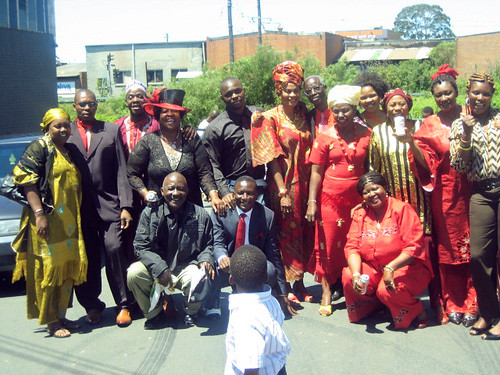
The celebration was marked with a Thanksgiving Service at the Lighthouse International Church, Granville, which was attended by both Christians and Muslims. Mr. Ibrahim Paul Sankoh, who gave the sermon, talked about hesitation and its adverse effects on mankind. He insinuated that hesitation makes many people not to get their desired goal even when it is at their finger’s tip.
Mr. Sankoh said we should not solely depend on our individual achievements but to focus our minds on the power of the Almighty God, who has the power to give and take.
In the vote of thanks given by Mr. James Koroma, the chairman of APC-Australia, he told the packed congregation that the APC-Australia chose that special day to thank God for what He had done for Sierra Leone. He said even though the country had gone through more than ten years of brutal war, Sierra Leoneans could still walk about with pride for their achievements.
Mr. James Koroma said with the arrival of the APC on the throne, a new era has come to Sierra Leone and that the Sierra Leonean people themselves were now in charge of their own destiny.
He said Sierra Leoneans could now breathe a sigh of relief as the new President, His Excellency Ernest Bai Koroma, was committed to promoting democracy, stability and development, which had eluded the people for so long, and would make Sierra Leone a new nation of pride and strength.
He then thanked the Pastor, elders and congregation of the Lighthouse International Church for hosting the occasion and asked all Sierra Leoneans for their support.
The chairman of APC-Australia then gave a brief history of the party which brought out the hard fact that history is wont to repeat itself.
The APC party, which is one of the two main political parties in Sierra Leone, before it first came to power in the late 1960s, had to tussle it out with the SLPP before finally being declared winner in the elections in those days when the colonial masters’ footsteps were still fresh on the Sierra Leonean soil.
The same episode, with the APC and SLPP battling it out again in elections that finally declared the APC as winner, recently occurred again. Both eras were marked by violence.
The Sierra Leone Peoples Party (SLPP), the incumbent ruling party that was recently defeated in a hotly contested election in Sierra Leone, was the first ruling party after the country gained independence from British colonial rule in 1961. The All Peoples Congress (APC) party, which was the opposition party, was steered by Siaka Stevens who later became the first President of Sierra Leone.
The first Prime Minister of the country called Sir Milton Margai died not long after independence and his brother, Sir Albert Margai, took his place as Prime Minister.
The elections that came after the Prime Minister’s term of office in the late 1960s was characterised by violence between the two parties which prompted the military to stage the first coup d’état in the country.
A combination of events, ranging from house arrests to imprisonments, eventually saw APC’s Siaka Stevens being declared the winner of the elections and he became Prime Minister in 1968, with the incumbent Prime Minister going into exile.
A few years after this event the country adopted the republican constitution and Sierra Leone was translated from an independent state to a republican single party state, with the Prime Minister becoming President. He ruled until 1985 and handed political power to a military officer, who later became a civilian President. The new president ruled for about seven years and was toppled in a military coup mounted by disgruntled young soldiers in their twenties in 1992 when the civil war was taking its toll on the population.
The soldiers ruled for four years and handed power back to a civilian government headed by the SLPP party. The SLPP ruled throughout the war and after the war while the APC remained the opposition party. Very recently, as stated, the ruling SLPP was defeated in the country’s elections by the opposition APC party headed by Ernest Bai Koroma. That defeat of an incumbent party in an election has been described as a strange phenomenon in African politics, for the incumbent party always has everything (state funds, the media, corrupt practices, etc.) at its disposal to win any election.
Showing posts with label church. Show all posts
Showing posts with label church. Show all posts
Thursday, November 22, 2007
APC victory celebrated in Australia

Wednesday, November 21, 2007
Salvation and opportunity at the Lighthouse
By Wenee Yap
 Wedged between a brothel and a mechanics' workshop in Granville is an unlikely source of salvation.
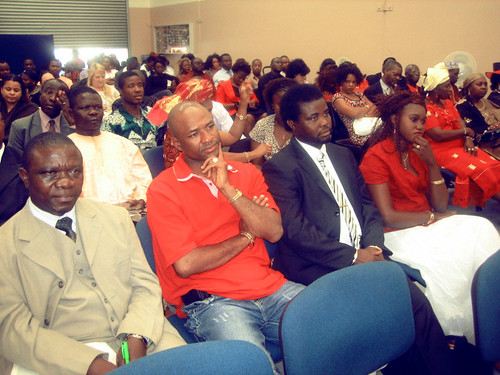
Every Friday night and Sunday morning, a predominantly African congregation gathers in the unassuming, peach-painted building to share "soul songs" and the Christian gospel.
 Wedged between a brothel and a mechanics' workshop in Granville is an unlikely source of salvation.
Every Friday night and Sunday morning, a predominantly African congregation gathers in the unassuming, peach-painted building to share "soul songs" and the Christian gospel.
Most members of the Lighthouse International Chapel come from war-ravaged Sierra Leone or other African countries such as Ghana, Kenya and South Africa. Some come from Asia, while others can trace their lineage to Russian aristocracy.
What unites them is their Christian faith and their belief in the equality of opportunity in Australia.
"My way of integration is 100 per cent through the church,'' said Alex Mwangi, a young Kenyan IT professional who started out working midnight shifts in a factory while studying to gain his qualifications.
 "My pastor - a great leader - gave me tips on how to get a job and a place to stay,'' Mr Mwangi said.
"Also, a Christian is a Christian everywhere. We are all Christians and we all love God and that helps our integration in the community, the way of life here.''
The Granville church, one of three Lightouse congregations in Sydney, was established about ten years ago.
"I think a lot of Africans are disappointed when they come to Australia, because they leave behind all their Third World problems and are faced with a new set of problems - First World problems,'' said Larissa Kernebone, a church member for four years and law student at the University of Technology, Sydney.
"A lot come over as students. Many of the church are upper class Africans. They understand that education is what they need to get out of poverty.''
Another member of the congregation, who asked to be identified only as John, emigrated from Sierre Leone and worked at a factory for six months when he first arrived in Australia.
"If you just work as a labourer, there are no prospects, you'll be in the same position for the next 20 to 30 years,'' he said.
John is about to complete his electrical engineering studies at Granville TAFE. He was a Christian before he joined the Lighthouse Chapel congregation in Sydney.
"Without Christianity, nothing else makes sense. People who lead such selfish lives, even when they are learned - they're so messed up.''
John left Sierre Leone at a time of civil war and chaos.
"[There was] no order, nothing made sense, yet they were fighting,'' he said. "It's like what happened in World War Two - killing Jews, killing babies. It didn't make sense. You saw humankind as evil, demonic. You saw people chopping others' hands off. You saw them chop off the limbs of a two year old child. Nobody can define why they did it. Killing innocent people, everybody kills everybody. It's just evil."
"I've made Australia my home. It's nice here - the opportunities you have, you can go at your own pace. You can help people, even with the little you have. To give is more blessed than even receiving. I thank God I can do that.''

Officiating pastor Ibrahim Sankoh delivering his sermon.
Subscribe to:
Posts (Atom)